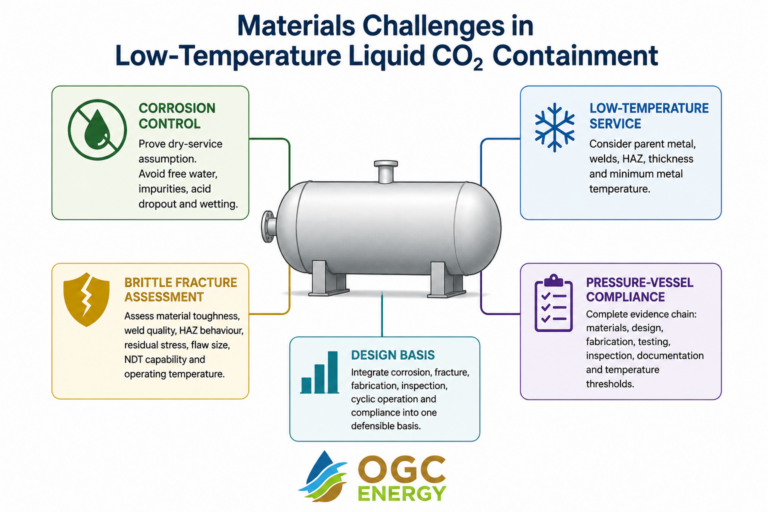
Materials and Corrosion Challenges in Offshore Dense-Phase CO₂ Transport
Materials and corrosion challenges in offshore dense-phase CO₂ transport
In early-stage offshore CCS design, the materials and corrosion challenge is rarely a single damage mechanism.
For dense-phase CO₂ export systems, normal operation can appear relatively benign if the CO₂ remains dry and the impurity envelope is controlled. Carbon steel may be a credible material option under those conditions. However, that statement only becomes technically meaningful when it is tied to the actual CO₂ composition, water content, operating pressure, temperature range, transient modes and system interfaces.
In a recent offshore CO₂ transport precedent, the principal engineering question was not simply whether carbon steel could be used. The most important question was whether the project could demonstrate that each part of the system would remain within a non-corrosive regime during normal operation, while also identifying the abnormal and transient cases that could challenge that basis.
The system considered dense-phase CO₂ export infrastructure including offshore pipeline, riser, subsea interfaces and associated topside. At pre-FEED and early design definition stage, this required a clear separation between credible normal-operation conditions and less frequent scenarios such as water ingress, residual construction water, off-spec CO₂, depressurisation, low-temperature exposure and local water retention.
Carbon steel suitability is conditional
Carbon steel in dense-phase CO₂ service is not a generic yes/no decision.
The suitability case depends on demonstrating dry service, maintaining the CO₂ specification and avoiding free water or corrosive liquid phases. The presence of water can form carbonic acid. Certain impurities can also influence phase behaviour, acid dropout, corrosion potential and decompression response.
This means that the materials selection basis cannot rely only on a general statement that dry CO₂ is non-corrosive. It needs to be linked to the specified CO₂ composition, impurity limits, water content, expected operating envelope and credible upset cases.
For CCS operators and developers, this is an early design-basis issue. If the corrosion assumptions are not aligned with the real CO₂ specification and operating modes, the project may either understate abnormal corrosion risks or introduce unnecessary conservatism.
Wet CO₂ is often an abnormal or transient problem
During normal dry dense-phase CO₂ operation, internal corrosion may not be credible. The challenge is that CO₂ transport systems do not only experience steady-state operation.
Water may be introduced during construction, hydrotesting, pigging, dewatering, commissioning or intervention. It may also enter through abnormal operating events or off-spec conditions. If free water is retained in low points, valves, pig trap interfaces, connectors, ID transitions or other stagnant locations, localised corrosion scenarios can become credible even where the bulk operating philosophy is dry.
This is why the corrosion assessment needs to define which wet CO₂ cases are credible, how they could occur, and whether they relate to construction, commissioning, operation, shutdown or upset conditions.
The practical engineering challenge is ranking of threats. A robust assessment should not treat all theoretical threats as equally likely, but it should also avoid dismissing wet CO₂ simply because normal operation is intended to be dry.
Interfaces can dominate the corrosion risk
In offshore CO₂ transport systems, average pipeline conditions may not govern the corrosion risk.
Local geometry and interfaces can be more important. Pig traps, low points, valves, dead legs, risers, subsea connectors, termination assemblies, skids and out-of-service tie-ins may create locations where water or deposits can accumulate. These locations require different thinking from the main flowing pipeline.
The same applies externally. Subsea and offshore components may see seawater exposure, seabed contact, marine atmospheric exposure, handling damage, laydown, recovery, coating damage, crevice formation and galvanic interfaces. A single generic offshore corrosion philosophy is often insufficient where the exposure changes between pipeline, riser, topsides, terminations and temporary installation conditions.
For CCS developers, the key point is that corrosion control is not only a material selection exercise. It is also an interface, constructability, preservation and operations issue.
Low temperature is a materials issue
CO₂ depressurisation can generate low metal temperatures. These transient conditions can govern material toughness requirements for pipelines, risers, topside piping and local components.
The minimum metal temperature may vary across the system. A topside blowdown case may not be the same as a subsea pipeline decompression case. Local restrictions, seabed heat transfer, buried or unburied conditions and inventory effects can all influence the credible low-temperature envelope.
This creates a materials challenge: the selected material grade, toughness basis and component specification must be suitable for the credible minimum temperature at the relevant location.
Low temperature should therefore not be treated only as a flow assurance output. It needs to be integrated into the materials selection, fracture control and component qualification basis.
Dense-phase CO₂ fracture control requires project-specific thinking
Ductile running fracture is a specific concern for dense-phase CO₂ pipelines.
CO₂ decompression behaviour differs from natural gas. For that reason, fracture-control assumptions used for conventional gas pipelines cannot simply be transferred without checking their applicability.
The key issue is not only whether a crack can initiate. It is whether a running ductile fracture can be arrested under the project-specific CO₂ inventory, pressure, temperature, pipe diameter, wall thickness, toughness and decompression response.
This is particularly important where the selected design approach, pipe size, wall thickness, toughness requirement or decompression model sits near or outside the straightforward validation limits of commonly referenced guidance.
For CCS operators, this is a design assurance issue. Referencing standards is necessary, but the assessment also needs to show that the methods are applicable to the actual pipeline design and CO₂ composition.
Screening out mechanisms still matters
A technically sound corrosion assessment should not only list credible threats. It should also document why some mechanisms are low-risk or non-credible.
For dry dense-phase CO₂ operation, mechanisms such as under-deposit corrosion, salt deposition, microbiologically influenced corrosion, oxygen-driven corrosion, sour corrosion and cracking may be screened out under defined conditions. However, that screening should be explicit.
This is important because early CCS projects often carry high uncertainty. A clear threat screening process helps avoid two common problems: overstating theoretical damage mechanisms that do not apply, or omitting abnormal cases that could realistically occur.
The design-basis challenge
For offshore CCS operators and developers, the materials and corrosion challenge is not simply to select carbon steel, apply coatings and cite dense-phase CO₂ guidance.
The real challenge is to define a credible design basis across normal operation, abnormal operation, transient conditions and local interfaces.
That means answering questions such as:
- Is the CO₂ stream dry under all normal operating conditions?
- Which water ingress or residual water cases are credible?
- Could impurities change the corrosion, phase behaviour or decompression basis?
- What is the credible minimum metal temperature for each part of the system?
- Does the fracture-control basis address dense-phase CO₂ decompression and arrest?
- Which interfaces or stagnant locations could behave differently from the bulk pipeline?
- Are external corrosion protection requirements specific to the real exposure conditions?
These questions need to be addressed early, because they influence material grade, toughness, wall thickness, corrosion allowance, coating, cathodic protection, preservation philosophy, commissioning requirements and operating limits.
For offshore CO₂ transport, the most important corrosion risk may not be the steady-state dry pipeline. It may be the abnormal, transient or local condition that challenges the assumption that the system is always dry, stable and uniform.
These are the types of materials and corrosion questions that need to be resolved early in CCS design. If you are working through similar CO₂ transport challenges, we are open to technical discussion and collaboration.