Materials challenges for low-temperature liquid CO₂ containment
Materials challenges in low-temperature liquid CO₂ containment
In liquid CO₂ transport and storage systems, carbon steel pressure-vessel tanks can appear to be a conventional engineering problem.
They are not.
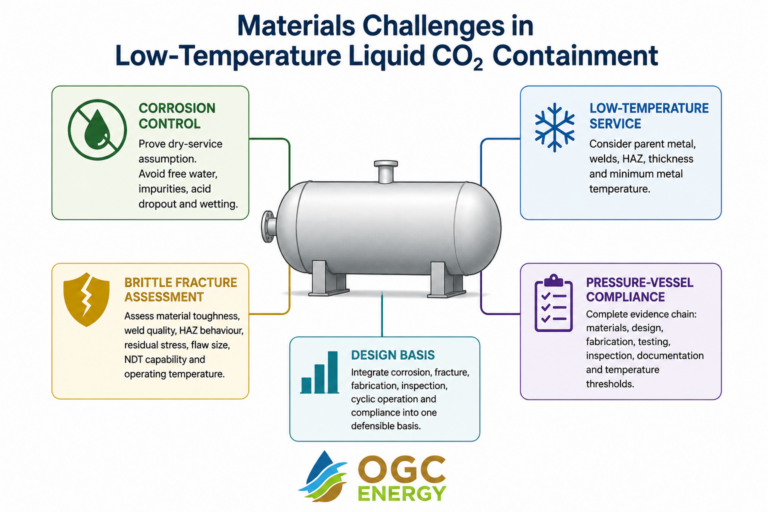
The technical challenge is not only selecting a pressure-vessel steel or confirming wall thickness. For low-temperature liquid CO₂ service, the materials case needs to connect corrosion mechanism screening, minimum metal temperature, brittle fracture resistance, weld qualification, fabrication effects, inspection capability, cyclic operation and pressure-vessel compliance into one defensible design basis.
In a recent anonymous CO₂ containment precedent, the asset consisted of large welded carbon steel pressure-vessel tanks for low-temperature CO₂ service. The project sat at the interface between CCS infrastructure, liquid CO₂ handling and transportable containment requirements. The key challenge was to define whether the selected materials and fabrication route could be justified across normal operation, credible abnormal conditions and applicable compliance routes.
This created a design-basis problem rather than a simple material-selection problem.
Carbon steel suitability depends on proving the dry-service assumption
Dry CO₂ does not create an aqueous corrosion mechanism. That point is important, because it prevents the corrosion assessment from overstating the risk during normal dry operation.
However, liquid or dense-phase CO₂ service does not remove the need to consider abnormal wet cases.
The suitability of carbon steel depends on demonstrating that free water is avoided and that the impurity specification does not create corrosive liquid phases. Residual water, water ingress, off-spec CO₂, acid dropout and local wetting can all challenge a dry-service assumption.
For CO₂ containment, corrosion allowance should not be treated as a substitute for environmental suitability. If free water or acid dropout is credible, the question is not only how much metal loss can be tolerated. The more fundamental question is whether the operating envelope remains compatible with the selected material.
The engineering challenge is therefore to define the boundary between normal dry service and credible abnormal wet CO₂ exposure.
Low-temperature service is a fracture qualification problem
Liquid CO₂ containment introduces low-temperature service requirements that cannot be addressed by material grade selection alone.
The materials case must consider parent plate, shell, heads, nozzles, weld metal and heat-affected zones. It also needs to account for thickness, fabrication route and the credible minimum metal temperature. In the precedent considered, the relevant low-temperature range included normal and credible minimum metal temperatures around -46 °C to -60 °C.
This matters because a material route that appears acceptable at one minimum design temperature may become more difficult to justify at a lower credible metal temperature or greater thickness.
Low-temperature qualification is therefore not simply a Charpy check. Charpy impact testing may be part of the evidence, but it may not close the brittle fracture argument on its own. The design basis may need to consider CTOD or other fracture toughness data, weld and HAZ sampling, reference defect assumptions, residual stress and inspection capability.
For CCS developers, the critical question is not only whether a steel can be supplied with low-temperature properties. It is whether the final welded vessel can be qualified for the actual temperature, thickness, stress state, defect tolerance and inspection basis.
Brittle fracture assessment links material, weld and inspection evidence
Brittle fracture risk is one of the central materials questions in low-temperature CO₂ containment.
The issue is not limited to parent material toughness. Large welded pressure-vessel tanks include weld metal, heat-affected zones, formed components, nozzles and local stress-raising details. These regions may not behave identically to the base plate.
A credible brittle fracture assessment needs to connect several elements:
- material toughness
- weld procedure qualification
- HAZ behaviour
- residual stress assumptions
- reference flaw size
- NDT sensitivity and sizing capability
- pressure-test conditions
- operating minimum metal temperature
This is why brittle fracture is a system-level argument. A project can have a technically attractive material, but still have an incomplete fracture basis if the weld qualification, inspection assumptions or defect-tolerance argument are not aligned.
For low-temperature CO₂ tanks, the question is not simply: “Does the plate have impact toughness?”
The better question is: “Can the welded vessel tolerate credible defects at the governing minimum metal temperature under the relevant loading condition?”
Pressure-vessel compliance is an evidence chain
Pressure-vessel compliance is often treated as a design calculation issue. For low-temperature CO₂ containment, that is too narrow.
The compliance case depends on a connected evidence chain covering material qualification, traceability, design calculation, fabrication controls, weld procedure qualification, production testing, NDT extent, hydrostatic testing, technical documentation, inspection records and design review.
A material may be technically suitable in principle, but still introduce project risk if the supporting evidence chain cannot be closed.
This is particularly important where low-temperature operation, high-strength steels, thick sections or non-standard approval routes are involved. The documentation has to demonstrate not only that the vessel has enough thickness for pressure, but that the material properties used in the design remain valid after forming, welding, heat treatment and production testing.
For CO₂ developers, this creates an important early-stage question: can the selected material and fabrication route be qualified within the chosen pressure-vessel compliance framework?
If not, the risk may not appear in the wall-thickness calculation. It may appear later in material certification, weld qualification, NDT acceptance, pressure testing or declaration of compliance.
The marine and transportable tank interface adds complexity
Some liquid CO₂ containment systems sit at the boundary between conventional pressure-vessel design and marine or transportable tank requirements.
This can create additional scrutiny.
A material route that appears acceptable under one pressure-vessel standard may face additional approval barriers when marine classification, Administration acceptance, Type C independent tank requirements, post-weld heat treatment or alternative stress-relief arguments are introduced.
This is not simply a paperwork issue. The interaction between standards can affect material selection, heat treatment, toughness qualification, weld procedure requirements and inspection expectations.
The difficult part of CO₂ cargo containment is often not choosing the strongest or most efficient steel. It is proving that the selected route remains acceptable across all applicable compliance interfaces.
For projects involving marine transport, offshore transfer or liquid CO₂ logistics, the materials basis needs to be developed with those interfaces in mind from the beginning.
Cyclic operation changes the integrity question
Liquid CO₂ containment may not be a purely static pressure problem.
Repeated filling, emptying, depressurisation and repressurisation cycles can create a cyclic integrity question. Thermal cycles and pressure cycles can make weld detail quality, surface imperfection control and NDT philosophy as important as base material strength.
A vessel may be acceptable for static pressure containment, but still require a more demanding argument where fatigue-sensitive details are present.
The materials and integrity assessment therefore needs to consider:
- pressure cycles
- thermal cycles
- weld toe geometry
- surface imperfections
- smooth transitions
- local stress concentrations
- inspection class
- NDT extent and capability
For CO₂ logistics vessels, this changes the emphasis. The question is not only whether the vessel can contain pressure once. It is whether the welded containment system can maintain integrity through the expected operating cycle history.
Fabrication route can change the design properties
For low-temperature CO₂ pressure vessels, material selection cannot be separated from fabrication.
TMCP, quenched and tempered or other higher-strength steels may be attractive for thickness and weight control. However, forming, welding, PWHT, simulated heat treatment and production test coupon requirements can affect yield strength, tensile strength and low-temperature toughness.
The design properties that matter are not only the values stated on an initial material data sheet. They are the properties of the final qualified vessel after fabrication.
This is especially important for thick welded sections and low-temperature service, where parent material, weld metal and HAZ performance must remain consistent with the design and fracture assumptions.
The process-materials interface governs the basis
Across all these issues, the operating envelope is central.
Small changes in pressure, temperature, water content, CO₂ impurity level or depressurisation rate can affect the governing materials question. A change in minimum metal temperature can alter the toughness route. A change in water content can alter the corrosion mechanism. A change in cyclic duty can alter the fatigue and inspection basis.
For liquid CO₂ containment, the materials and corrosion case is only as strong as the operating envelope definition.
That operating envelope needs to cover normal service, filling and emptying, loading and unloading, depressurisation, dry dock events, abnormal low-temperature cases and off-spec CO₂ excursions.
For CCS operators and developers, this is the main lesson from the anonymous precedent: low-temperature liquid CO₂ containment is not a single-discipline problem.
It requires the process basis, corrosion assessment, fracture qualification, pressure-vessel code compliance, fabrication route and inspection philosophy to be aligned.
These are the types of materials and corrosion questions that need to be resolved early in CO₂ transport and storage design. If you are working through similar challenges, we are open to technical discussion and collaboration.