CO₂ Injection Wells: Five Materials and Integrity Challenges Before First Injection
CO₂ Injection Wells: Five Materials and Integrity Challenges Before First Injection
Why dry CO₂, formation-water ingress, impurity chemistry, material qualification and well barriers must be considered together.
As carbon capture and storage (CCS) projects progress towards first injection, an important materials question remains: has the injection well been designed for the full range of environments it may experience, or mainly for the CO₂ composition during normal operation?
During continuous injection, a well may receive dry CO₂ with a controlled impurity specification. Under suitable conditions, carbon steel can be compatible with this environment because the aqueous phase required for conventional electrochemical CO₂ corrosion is absent.
However, an injection well is not simply a continuation of the transport system.
It connects an industrial CO₂ stream with a geological formation containing fluids that may differ substantially from the injected CO₂. The well also experiences start-up, shut-in, pressure changes, interventions and potentially long periods of intermittent operation.
Formation-water contact, reactive impurities, low-temperature transients and changing reservoir conditions can therefore create more demanding requirements than those identified from the nominal injection fluid.
Five technical challenges deserve particular attention.
-
Dry CO₂ injection does not necessarily mean a dry well
Dry CO₂ can be effectively non-corrosive to carbon steel when free water and corrosive secondary liquid phases are absent.
That principle is well established in CO₂ transport. However, applying it to injection wells requires consideration of the entire operating envelope.
During normal injection, the fluid inside the tubing may remain dry. During pre-commissioning, well clean-up, shutdown, intervention or backflow, the internal environment can change.
A well may experience contact with formation brine, completion fluids or other water-bearing fluids. If water contacts CO₂, the resulting aqueous phase may become corrosive to carbon steel.
This distinction has been demonstrated in engineering assessments of CO₂ injection wells where normal dry injection presented a low corrosion risk, while pre-start-up and formation-water exposure required a substantially different materials assessment.
The important consideration is not simply whether water is present, but also the fluid composition, temperature, pressure, exposure duration and whether the material can tolerate the resulting environment.
For injection wells, this means the corrosion assessment must distinguish between normal operating conditions and the less frequent scenarios that could govern material selection.
A material suitable for continuous dry CO₂ injection is not automatically suitable for every operating mode of the well.
-
Formation-water ingress and completion design can govern material selection
One of the fundamental differences between CO₂ transport and geological injection is the potential for contact with formation fluids.
In saline aquifer storage, the injection formation contains brine. Depending on the well configuration, reservoir pressure, wellbore pressure and fluid distribution, formation water may move towards or into the lower completion during shutdown or pressure reversal.
As injection progresses, reservoir pressure can also change, potentially altering the magnitude and duration of backflow during subsequent shutdowns.
This means that a completion which experiences predominantly dry CO₂ during injection may be exposed to CO₂-saturated brine during other operating conditions.
A separate concern is unintended fluid movement involving other geological intervals.
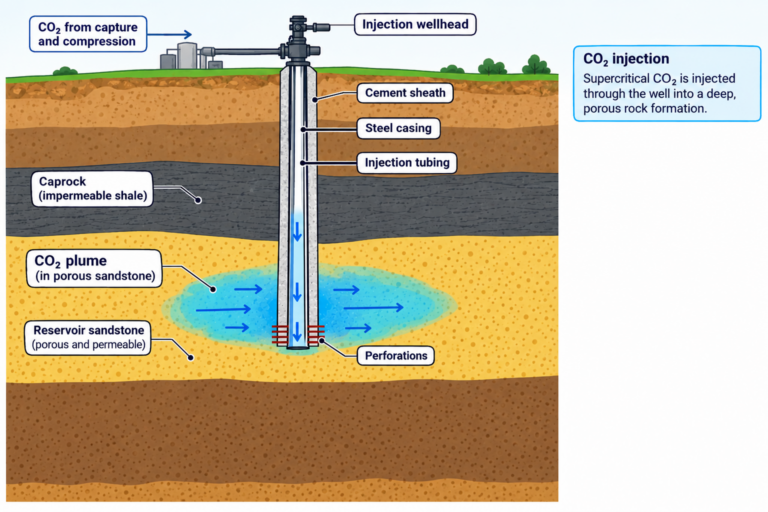
Where a well crosses saline formations, the integrity of casing, cement, packers and other barriers must prevent unintended communication between zones. A loss of zonal isolation may allow fluids to enter annular spaces or migrate along an unintended pathway.
These are different mechanisms:
- Formation-water backflow: movement of reservoir fluids from the intended injection formation towards the completion under favourable pressure conditions.
- Unintended interzonal flow: fluid movement involving other formations or annular pathways, potentially associated with inadequate or degraded zonal isolation.
Both require consideration, but their engineering controls and consequences are different.
The completion design should establish whether fluid backflow is credible, which components could be exposed, what pressure differentials are expected and whether the selected materials remain compatible.
It should also demonstrate that the required well barriers and zonal isolation can be maintained throughout the planned lifecycle.
Additional completion features, flow-control arrangements or more resistant materials may be appropriate in some applications. However, no single advanced completion configuration is universally required.
The requirement is not to make every completion more complicated, but to demonstrate that its design addresses the actual formation-fluid and operating conditions.
-
Acid dropout adds another dimension to CO₂ well corrosion
Conventional CO₂ corrosion occurs when an aqueous electrolyte is present. CO₂ dissolves in the water, producing carbonic acid and establishing an environment in which carbon steel corrosion may occur.
However, industrial CO₂ streams can also contain reactive impurities such as SO₂, NO₂, O₂ and H₂S.
Under certain combinations of composition, pressure, temperature and water availability, these impurities can react to form highly acidic secondary liquid phases, including sulphuric- and nitric-acid-containing condensates.
This phenomenon is commonly described as acid dropout.
An important distinction is that acid-rich phase formation may occur below the water saturation limit predicted for a simpler CO₂–water system.
Therefore, demonstrating that the stream is below a conventional water dew-point limit does not, by itself, establish that all possible impurity-related corrosion mechanisms have been excluded.
For injection wells, the assessment needs to consider whether the specified CO₂ composition could produce such phases under credible well operating conditions.
This does not mean that acid dropout will occur in every CCS injection well.
Its credibility depends on the actual impurity combinations, their concentrations, reaction kinetics, phase behaviour and the pressure/temperature history of the fluid. Laboratory observations from dense-phase CO₂ transport cannot automatically be assumed to apply throughout a particular well.
It is also important to distinguish impurity-derived acid dropout from the formation of carbonic acid when CO₂ contacts reservoir brine.
These are different chemical environments and may present different material compatibility challenges.
Other impurity reactions may produce solid phases, such as elemental sulphur or certain ammonium salts. Where their formation is credible, questions may arise regarding deposition in valves, completion restrictions and the injection interval.
The engineering challenge is therefore broader than defining maximum impurity concentrations.
It is establishing what chemical phases can form from the actual CO₂ stream, whether they can contact well components and whether the selected materials are qualified for those exposures.
-
Material qualification remains a significant challenge
Material selection for CCS injection wells often considers carbon steel, conventional 13Cr, supermartensitic 13Cr and higher-alloy corrosion-resistant materials.
Each has an established body of experience from oil and gas production, gas injection or CO₂-enhanced oil recovery.
However, CCS applications may introduce different combinations of CO₂ purity, reactive impurities, saline formation water, operating temperature, pressure and exposure duration.
A material’s corrosion resistance cannot therefore be established by alloy designation alone.
For example, conventional 13Cr stainless steel can perform satisfactorily in many CO₂-containing environments, but its suitability is conditional on chloride concentration, temperature, pH, H₂S exposure, oxidising species and metallurgical condition.
Supermartensitic grades and higher-alloy corrosion-resistant materials can extend the available operating envelope, but they are not universally immune to localised corrosion or environmentally assisted cracking.
Published CCS materials-selection literature identifies an important evidence gap: much of the available qualification experience originates from conventional oil and gas applications, while direct experimental data for several corrosion-resistant alloys exposed to representative mixed-impurity CCS streams remain limited.
This is particularly important when a material is selected using established sour-service guidance.
Compliance with ISO 15156/NACE MR0175, where applicable, does not by itself demonstrate compatibility with every CCS-specific impurity combination or operating condition.
The assessment should distinguish between an alloy that has an established history of satisfactory performance and one whose suitability has been demonstrated for the project’s actual exposure conditions.
The qualification problem also extends beyond metallic tubulars.
Injection wells contain connections, packers, sealing elements, elastomers, cement and other components that contribute to long-term containment.
Elastomer qualification may need to address CO₂ permeation, swelling, chemical compatibility and rapid gas decompression under the relevant pressure and temperature cycles.
Cement performance depends on material chemistry, placement quality, bonding, mechanical loading and exposure to CO₂-bearing fluids. Cement carbonation does not automatically indicate a loss of integrity; the presence and evolution of connected leakage pathways are particularly important.
For CCS operators, this creates a broader qualification question:
Has the complete well barrier system been qualified for the credible chemical, thermal and mechanical conditions, rather than only the nominal injection fluid?
-
Well barriers and operating transients must be considered together
NORSOK D-010 provides an established framework for well integrity through the well lifecycle, including the definition, verification and monitoring of well barriers and their constituent elements.
Its general philosophy uses defined barrier envelopes to control potential uncontrolled flow, with the required configuration determined by the activity, well conditions and applicable barrier criteria.
This approach is relevant to CCS, but geological CO₂ storage introduces additional considerations.
A 2024 SINTEF study commissioned by Standards Norway concluded that existing NORSOK well-integrity principles remain broadly applicable to CCS wells. However, it identified the need for more explicit consideration of CO₂ storage conditions, evolving reservoir pressures, cyclic loading and the different sources of inflow encountered over the well lifecycle.
For a CO₂ injection well, important well barrier elements can include tubing and connections, casing, cement, packers, wellhead equipment and downhole valves, depending on the design.
These components may experience repeated changes in pressure and temperature.
During start-up, shut-in, restart or depressurisation, CO₂ expansion and phase changes can produce significant thermal transients. Depending on the operating conditions, metal temperatures may fall below the qualified temperature range of some components.
Repeated injection and shutdown cycles can also impose mechanical loading on tubing, packers, cement and casing.
The potential consequences include changes in sealing performance, fatigue-sensitive loading, cement debonding and development or enlargement of micro-annular pathways.
These effects are not inevitable. Their significance depends on the magnitude and frequency of the loads, component qualification and the condition of the installed barriers.
For saline aquifer injection, changes in injectivity introduce another interaction.
Under suitable conditions, dry CO₂ injection can lead to water evaporation and salt precipitation near the wellbore. This can reduce local permeability and influence the injection pressure required to maintain flow.
Such pressure changes may subsequently affect the loads experienced by the well completion.
The integrity assessment therefore needs to connect the reservoir operating envelope with the materials and well barrier design.
The key requirement is not simply selecting components capable of withstanding the maximum design pressure.
It is demonstrating that the well barriers remain effective through the credible combinations of pressure, temperature, fluid chemistry and operating cycles.
From FEED to first injection: what evidence is needed?
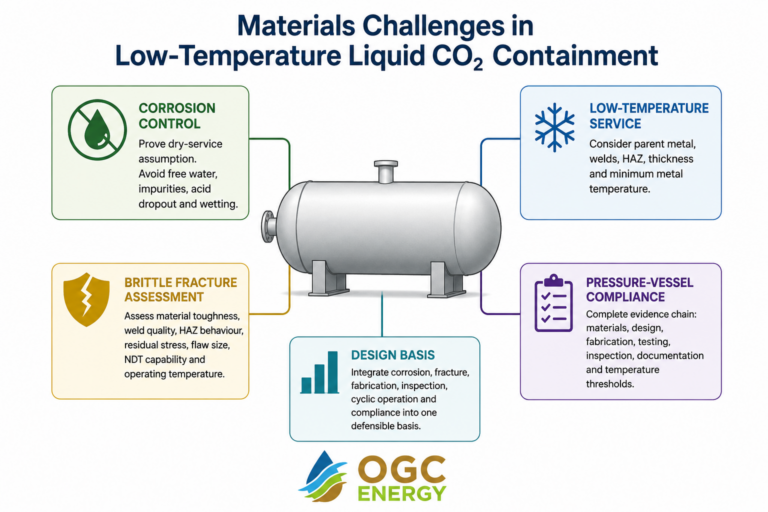
The materials and integrity case should connect the CO₂ specification, formation-fluid chemistry, completion architecture, material qualification and well operating philosophy.
An assessment should be able to answer several practical questions:
- What fluids can contact each well component during normal injection, shutdown, intervention and restart?
- Can formation water enter the completion, and under which pressure conditions?
- Are unintended interzonal fluid movements prevented by the specified well barriers?
- Could reactive CO₂ impurities form corrosive secondary phases under credible conditions?
- Are the tubing, connections, packers, seals and cement qualified for the relevant exposure conditions?
- Can pressure and thermal cycling affect the integrity of any well barrier element?
- How will the important integrity limits be monitored, and what action follows an excursion?
These questions need to translate into an operating integrity framework:
Scenario → Physical condition → Damage mechanism → Integrity limit → Detection → Action
For example, if formation-water backflow is credible during shut-in, the project should define the possible exposure, relevant materials limits and restart requirements.
If an impurity excursion can challenge material compatibility, the project requires a technically suitable detection and operating response.
If a thermal transient could exceed the qualification limits of a completion component, the operating procedure must account for that restriction.
This is where the materials assessment becomes an operating integrity control rather than a design document alone.
Conclusion: the governing environment may not be normal injection
For CO₂ injection wells, the most demanding materials environment may arise during shutdown, formation-water contact, intervention, abnormal fluid composition or restart.
These conditions cannot be evaluated independently of the completion design, well barriers and reservoir behaviour.
Standards such as NORSOK D-010 provide the fundamental well-integrity framework, while geological storage guidance and project-specific materials assessments establish the additional CCS requirements.
The objective is not to introduce unnecessary complexity or conservatism.
It is to identify credible exposure conditions, qualify the materials and barriers against those conditions, and define how integrity will be maintained and verified during operation.
For CCS injection wells, material suitability is not only a question of what is being injected. It is also a question of what can enter the well, how the well behaves when injection stops, and what the completion must withstand over its life.
These are the challenges OGC Energy continues to explore through materials selection, corrosion assessment and well-integrity engineering.
We welcome technical discussion and collaboration with CCS operators, developers and engineering providers addressing similar questions.
Selected technical references
- NORSOK D-010:2021+AC:2024 — Well integrity in drilling and well operations, Standards Norway.
- ISO 27914:2026 — Carbon dioxide capture, transportation and storage — Geological storage.
- SINTEF (2024), CCS Well Design Requirements, Report 2024:00065, prepared for Standards Norway.
- Craig, B. et al. (2023), Guidelines for the selection of corrosion resistant alloys for CCS and CCUS injection wells, International Journal of Greenhouse Gas Control, 129, 103988.
- Sonke, J. et al. (2024), Corrosion and chemical reactions in impure CO₂, International Journal of Greenhouse Gas Control, 133, 104075.
- Ahammad, F. and Azadbakht, S. (2025), A comprehensive review of factors affecting wellbore integrity in CO₂ injection wells, Energy Geoscience.